
Short Multiplication
With 1 digit multiplication it's very easier to work out solutions or just memorise them. WIth 2 digit multiplication it gets harder. If you are multiplying a 1 digit number by a 2 or 3 digit number, there is a very simple method. First you arrange the numbers into collumns like this:
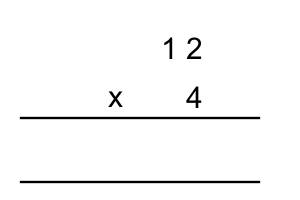
Then we take the second number in the equation, which in this case is 4, and multiply it by the number in the ones collumn of the first number in the equation, which is 2. We get 8, which we write down in the ones collumn. Then we multiply the 4 by the number in the tens collumn, which is 1, to get 4. We now write down the 4 in the tens collumn and our answer is 48.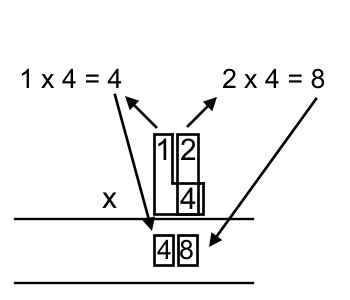
However sometimes when we multiply the numbers in the ones collumn, we end up with a 2-digit number. When this happens, we take the answer, take out the number in the ones column and take the number in the tens collumn and remember it for later. Then we multiply the number in the tens column, add on the number that we remembered from before, and put that as our answer for the tens column. For example, in 26 x 4, when we multiply 4 by 6 we get 26. We write down 6 as our answer for the ones column and keep the 2. Then when we multiply 4 by 2, we get 8. We add 8 with the number from before, which is 2 and we get 10 as our answer for the tens collumn. We leave the tens collumn as a 0 and move to the hundreds column and put a 1 for that.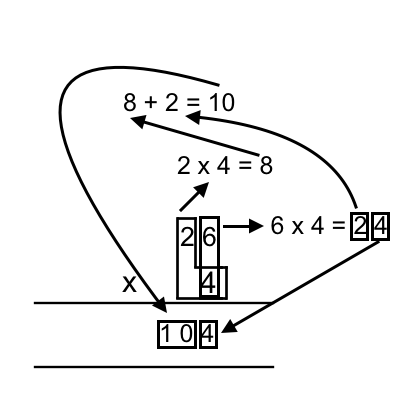
Then we take the second number in the equation, which in this case is 4, and multiply it by the number in the ones collumn of the first number in the equation, which is 2. We get 8, which we write down in the ones collumn. Then we multiply the 4 by the number in the tens collumn, which is 1, to get 4. We now write down the 4 in the tens collumn and our answer is 48.
However sometimes when we multiply the numbers in the ones collumn, we end up with a 2-digit number. When this happens, we take the answer, take out the number in the ones column and take the number in the tens collumn and remember it for later. Then we multiply the number in the tens column, add on the number that we remembered from before, and put that as our answer for the tens column. For example, in 26 x 4, when we multiply 4 by 6 we get 26. We write down 6 as our answer for the ones column and keep the 2. Then when we multiply 4 by 2, we get 8. We add 8 with the number from before, which is 2 and we get 10 as our answer for the tens collumn. We leave the tens collumn as a 0 and move to the hundreds column and put a 1 for that.
Long Multiplication
What about when we are multiplying two 2-digit numbers together. Now we use long multiplication, which is like short multiplication but only expanded. We start doing the same things as with short multiplication. First we organise the numbers into collumns.
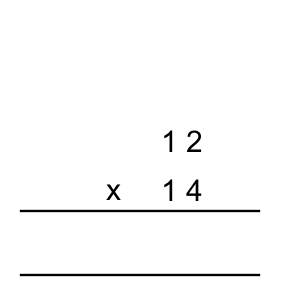
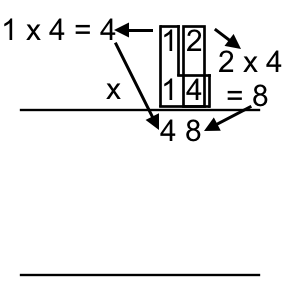
Then we do the same with the short multplication and take the number from the ones column of the second number and multiply it by the numbers in both of the columns of the first number. Using our example of 12 x 14, we take the 4 from the 14, and multiply it by the 2 and the 1 in the 12, to get 4 and 8.
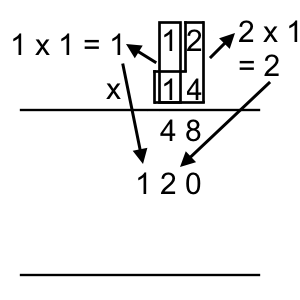
Then we move below the 48, and we write a 0 in the ones collum of this new line. We take the number from the tens collumn of the second number and multiply it by both of the digits in the first number. So in this example, we put the 0 in the ones collumn first, then we take the 1 from the 14 and multiply it by the 1 and 2 in the 12 to get 1 and 2, which we put in the hundreds and tens column.
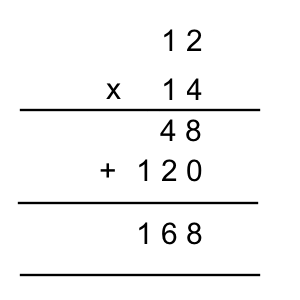
Then finally we add our two answers together, which in this case are 48 and 120, and now we get 168.
Long Multiplication
Remainder
Long Division
Divisibility Rules
2 Digit Division
2 Digit Multiplication
Then we do the same with the short multplication and take the number from the ones column of the second number and multiply it by the numbers in both of the columns of the first number. Using our example of 12 x 14, we take the 4 from the 14, and multiply it by the 2 and the 1 in the 12, to get 4 and 8.
Then we move below the 48, and we write a 0 in the ones collum of this new line. We take the number from the tens collumn of the second number and multiply it by both of the digits in the first number. So in this example, we put the 0 in the ones collumn first, then we take the 1 from the 14 and multiply it by the 1 and 2 in the 12 to get 1 and 2, which we put in the hundreds and tens column.
Then finally we add our two answers together, which in this case are 48 and 120, and now we get 168.
Lessons:
Multiplication TableLong Multiplication
Remainder
Long Division
Divisibility Rules
Activities
1 Digit Multiplication2 Digit Division
2 Digit Multiplication